Tuesday, October 11, 2011


Recipe for English Muffins
English Muffin Extravaganza
Yields six muffins
{source}
2.25 cups flour (I used bread flour)
1/2 Tbsp sugar
1/4 tsp salt
1.25 tsp active yeast
1 Tbsp butter or shortening (at room temperature)
3/4 - 1 cup milk (enough to make a dough)
In a large bowl, mix all dry ingredients. Mix in shortening and 3/4 cup milk (or more until soft dough emerges).
On a lightly floured surface, knead the dough for about ten minutes, resist adding more flour dough will be sticky but very manageable after a couple of minutes of kneading.
Lightly oil a bowl, place dough ball in bowl and turn it so that all sides of the dough are coated with oil. Cover with plastic wrap and let rise for one hour.

Line a cookie sheet with parchment paper, sprinkle with corn meal. Separate the dough into six equal pieces and roll into a ball. Place balls on cookie sheet, allowing enough room between each so that they have room to rise. Sprinkle the tops of the dough balls with more cornmeal. Cover loosely with plastic wrap and let rise one hour.
Heat oven to 350 degrees F and heat a greased skillet on medium high heat. Add about three of the balls of dough to the skillet, cooking for 5-8 minutes or until nearly burned, flip and repeat on other side.Repeat process until all muffins are browned.
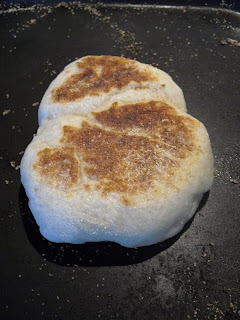
Place browned muffins on an ungreased cookie sheet.Bake for 6-8 minutes. Remove from pan immediately, cool on wire rack for 30 minutes.

Yields six muffins
{source}
2.25 cups flour (I used bread flour)
1/2 Tbsp sugar
1/4 tsp salt
1.25 tsp active yeast
1 Tbsp butter or shortening (at room temperature)
3/4 - 1 cup milk (enough to make a dough)
In a large bowl, mix all dry ingredients. Mix in shortening and 3/4 cup milk (or more until soft dough emerges).
On a lightly floured surface, knead the dough for about ten minutes, resist adding more flour dough will be sticky but very manageable after a couple of minutes of kneading.
Lightly oil a bowl, place dough ball in bowl and turn it so that all sides of the dough are coated with oil. Cover with plastic wrap and let rise for one hour.

Line a cookie sheet with parchment paper, sprinkle with corn meal. Separate the dough into six equal pieces and roll into a ball. Place balls on cookie sheet, allowing enough room between each so that they have room to rise. Sprinkle the tops of the dough balls with more cornmeal. Cover loosely with plastic wrap and let rise one hour.
Heat oven to 350 degrees F and heat a greased skillet on medium high heat. Add about three of the balls of dough to the skillet, cooking for 5-8 minutes or until nearly burned, flip and repeat on other side.Repeat process until all muffins are browned.

Place browned muffins on an ungreased cookie sheet.Bake for 6-8 minutes. Remove from pan immediately, cool on wire rack for 30 minutes.

(They look like the real deal!)
Lesson 1: Gluten
I love bread. I haven't met a kind of bread that I did not like. In fact, I am pretty certain that bread and I are soul mates, designed for one another is a kismet fashion. I could go on and on about all the kinds of breads that are out there from flat breads to Irish soda breads, the world of breads will never cease to amaze me. But that's not what I am here to talk about. I am here to talk about chemistry.


The basis to any bread is flour. In the baking world, there are multiple types of flour including: whole wheat flour, rye flour, peanut flour, cake flour, all-purpose flour, bread flour, etc. The list can problem travel down one arm and up the other. Flour is serious business. Certain flours are exchangeable because they are similar in chemical properties. Others would be absolute destruction if used in exchange for another type of flour.
Bread flour is high in gluten content. Now you are probably staring blankly at the screen wondering why you even decided to read this blog. Trust me, I questioned my sanity, the universe, and all of my morals and principles when I encountered that little factoid too. But it's simple, or at least it will be once I am through explaining. Gluten is the fabulous little doodad that gives the bread its texture and helps support the bread when it is rising. It basically just helps things stick together.
Look at a piece of bread. Like, hold it up to your nose. Now do you see those little holes? Those were created by the release of CO2 from yeast (my best friend and a matter to be discussed soon). But, the reason that the bread does not just crumble and fall apart because of all the air bubble escape pods is because of the gluten. The gluten traps most of the gases that are released during the rising phase.
The Chinese deemed gluten as the "muscle of flour" because it is essentially what gives bread it's strength. Gluten is made up of proteins. Flash back to high school biology, what is a protein? If you were not scared off by my mentioning of high school, then you are still reading this and have already googled "what is a protein?". Job well done. A protein is basically a long string of amino acids. Gluten proteins are around one thousand amino acids long. All of the sudden the whole "muscle of flour" nickname makes sense.
When the gluten is dry it does not move or transform, once in contact with water the gluten molecules are able to move, form, and break bonds with each other. In other words, it gets sticky and mushy. Like play-doh.
Let's recap. Firstly, any serious baker knows that there are several types of flour, each serving a unique purpose. Why? Because they have different chemical compositions. Bread flour is high in gluten, which means that it is an excellent choice if you want to use it with yeast since it is such a powerful force in entrapping the gases. Trapping the gases= making the bread rise. That is the reason behind the whoosh of air that escapes whenever you "punch down" bread that has been rising.

Not all baked goods want to work with flours that are high in gluten content. For instance, cakes and pastries pretty much detest gluten. Like seriously, they just do not get along. But we'll get more into that when the time comes.
Shortening-whether it's butter, margarine, or lard-interferes with the way gluten-forming proteins in flour interact with water. This makes for short strands of gluten, which is the key to flaky pastries and crusts.
Whole wheat flour contains about 14% protein, while pastry flour might contain half as much. You can find out how much protein is in a flour by looking at the nutritional information on the package!
Gluten is both plastic-able to change shape-and elastic-able to spring back into place.
Gluten is not only used in baking. It's also great for "beefing up" vegetarian cooking.
Recipes for cornbread and pancakes often warn you not to mix the batter too much. For these breads, overmixing can make the gluten too strong, which makes for a tough, chewy finished product.

When the gluten is dry it does not move or transform, once in contact with water the gluten molecules are able to move, form, and break bonds with each other. In other words, it gets sticky and mushy. Like play-doh.
Let's recap. Firstly, any serious baker knows that there are several types of flour, each serving a unique purpose. Why? Because they have different chemical compositions. Bread flour is high in gluten, which means that it is an excellent choice if you want to use it with yeast since it is such a powerful force in entrapping the gases. Trapping the gases= making the bread rise. That is the reason behind the whoosh of air that escapes whenever you "punch down" bread that has been rising.

Not all baked goods want to work with flours that are high in gluten content. For instance, cakes and pastries pretty much detest gluten. Like seriously, they just do not get along. But we'll get more into that when the time comes.
Did you know?
Shortening-whether it's butter, margarine, or lard-interferes with the way gluten-forming proteins in flour interact with water. This makes for short strands of gluten, which is the key to flaky pastries and crusts.
Whole wheat flour contains about 14% protein, while pastry flour might contain half as much. You can find out how much protein is in a flour by looking at the nutritional information on the package!
Gluten is both plastic-able to change shape-and elastic-able to spring back into place.
Gluten is not only used in baking. It's also great for "beefing up" vegetarian cooking.
Recipes for cornbread and pancakes often warn you not to mix the batter too much. For these breads, overmixing can make the gluten too strong, which makes for a tough, chewy finished product.
(I'm a video. Click me.)

* Source: McGee, Harold. On Food and Cooking: The Science and Lore of the Kitchen. New York: Scribner, 2004.
Monday, September 12, 2011
The Meaning
Humans are an interesting sort. We have mostly the same compositions, arms, legs, a brain, and a nose. But, we are not identical cookie cutters. As much as I love the idea of using cookie cutters for my baking adventures in the holiday months, I find it irritating to apply the same concept to people. The beauty of this life is that we are all different and that because we are different we have a purpose each and every day, assigned by no one in particular. That purpose is: to learn. We try, touch, sense, believe, hear, act, and observe so much throughout the day that is challenging not to absorb some piece of information, whether it is a blurb from the seemingly popular show "Jersey Shore" or if it is from the woman at Subway who makes your daily turkey sandwiches.
I have found myself to be a very inquisitive person, especially when it comes to human beings. I am always interested in the mechanisms of how we learn, love, survive, read, retain information, make friends, etc. To me, it is fascinating.This is probably a good reason why I chose to be a Psychology major. To those, however, who are not so inclined to people watching (a characteristic that I decided to label as endearing, instead of strange) Psychology is of no interest. They might, perhaps, live for Chemistry. I will tell you right now, these people are the most interesting. Particularly because of why they like the science, what is it about the subject that is so fascinating. I see pretty drawings and seven syllable words, while others see beyond that and actually understand what is going on. But more than that, they care.
From my first encounters sophomore year in high school with Chemistry it has been the bane of my existence. Perhaps I was never taught correctly? But now that I have enlisted myself in "Chemistry in the Day of the Life of Dr. Caswell", I am beginning to realize just how interesting the subject is. Not the minute details, that is. If you start drawing little hexagons on the board I am pretty sure that I would fall asleep. I am a chemistry narcoleptic. In all seriousness, I began to examine my life in order to see if I really encountered chemistry on a daily basis. Starting with my favorite pastime, baking. I am an avid baker with the hopes of one day owning my own bakery. My expertise? Bread. Yeast is now one of my best friends. I know a thing or too about yeast, as any baker should. There are golden rules, a sort of baking ten commandments if you will, when dealing with yeast. Firstly, moisture and yeast do not mix. Highly humid atmospheres have negative affects on whatever you happen to be baking. Why? I suppose something chemical. Secondly, salt is the kryptonite of yeast. It will destroy the yeast in a single menacing blow. Why? I'm going to guess that it has to do with chemistry... Thirdly, adding water to yeast is a bad idea, that is unless you like unleavened bread. Why? Chemistry.
I see the actions and the outcomes of chemistry, but I have no idea how to explain them or have a single clue as to where to look. On google? In the library? Should I ask a chemistry major? Should I ask a famous baker? Therein lies my problem. Thousands upon thousands of observations and questions just piling up until I just figure that that is the way it is and I drop it. But, learning is important to me. It is a vital aspect to being an active human being. So here I mark my quest in examining the chemistry of my own life, put in my own words, so that I may be able to help someone else out there.
I am the Betty Crocker Chemist.
Subscribe to:
Posts (Atom)